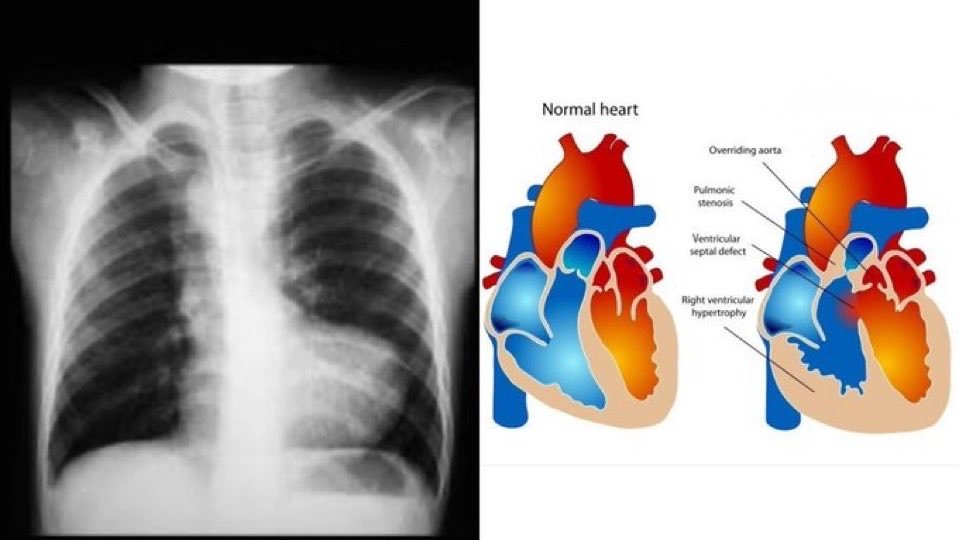
Q. What is the most common cause of cyanotic congenital heart disease?
A) Ventricular Septal Defect (VSD).
B) Atrial Septal Defect (ASD).
C) Tetralogy of Fallot (TOF).
D) Patent Ductus Arteriosus (PDA).
✓ The Correct Answer is:
C) Tetralogy of Fallot (TOF).
Tetralogy of Fallot (TOF) is the most common cyanotic congenital heart disease beyond the neonatal period.
The condition results from an anterosuperior displacement of the infundibular septum, leading to four classic cardiac abnormalities:
- Ventricular septal defect (VSD).
- Right ventricular outflow tract obstruction (pulmonary stenosis).
- Overriding aorta.
- Right ventricular hypertrophy.
Pulmonary stenosis increases right ventricular pressure, causing a right-to-left shunt through the VSD. As a result, deoxygenated blood enters the systemic circulation, producing cyanosis.
Classic Clinical Features- Patients may present with-:
- Central cyanosis.
- Cyanotic ("Tet") spells.
- Squatting during episodes of breathlessness (older children).
- Clubbing in longstanding disease.
- Harsh ejection systolic murmur due to pulmonary stenosis.
High-Yield Examination Points-:
- Most common cyanotic congenital heart disease (after the neonatal period): Tetralogy of Fallot.
- Most common congenital heart disease overall: Ventricular Septal Defect (VSD).
- Most common acyanotic congenital heart disease: Ventricular Septal Defect (VSD).
- Chest X-ray finding in TOF: Boot-shaped heart (Coeur en sabot).
- Definitive treatment: Surgical correction.
✓ Remember the mnemonic PROVe:
P – Pulmonary stenosis.
R – Right ventricular hypertrophy.
O – Overriding aorta.
V – Ventricular septal defect.
✓ Take-Home Message:
When asked, "What is the most common cause of cyanotic congenital heart disease?" the best answer for MBBS and NEET PG examinations is Tetralogy of Fallot (TOF).
Also remember that VSD remains the most common congenital heart defect overall, making this distinction a frequently tested concept.